
What Six Weeks in Europe Taught Me About HVAC, Travel, and Cheap UK Stocks
Investment ideas and field notes from a summer teaching in Rome

Air conditioning is becoming a political and economic flashpoint in Europe. It’s an investment theme to have on your radar.
I just returned from a six-week stay in Europe, built around a five-week university teaching stint in Rome with stops in London and Paris. The heat was impossible to ignore and impacted every leg of our journey.
European summers are getting hotter, and across much of the continent, air conditioning is either legally restricted or economically out of reach due to high electricity costs.
During the June heatwave in London, for example, our rental flat lacked air conditioning (as most London flats do). At night, our room temperatures were in the low 30s Celsius (high 80s in Fahrenheit). This made it difficult to sleep, which had compounding effects and sapped our energy.
It’s not surprising that it’s negatively impacting European GDP.
During 34 days in Rome, only one was below 90F and most were in the mid- to upper-90s. In the US, those temperatures aren’t newsworthy, but it feels much different when buses, museums, churches, restaurants, and other destinations lack AC. (Fortunately, our Rome apartment had AC.)
While the heat index may be higher in the US, the misery index is higher in Europe when the mercury is rising.
I wrote about this theme in July, along with a few stock ideas on the theme, for premium Flyover Stocks subscribers. Relative to other continents, Europe has been warming the fastest and the trend of brutal summers seems to be getting stronger.
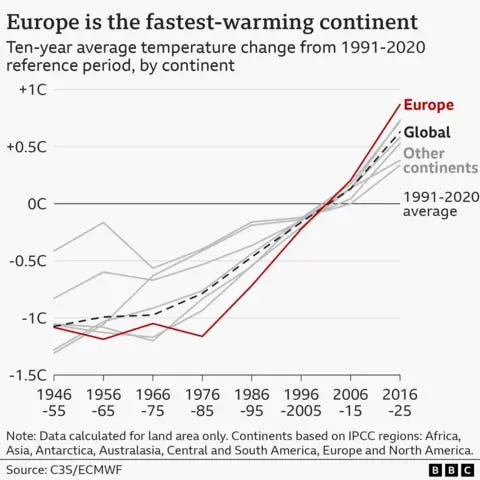
Europe as a whole tends to be more climate-conscious and has favored mitigation rather than adaptation policies, hoping that lower collective air-conditioning use will keep urban temperatures at bay.
While mitigation efforts may be more ethical and may be the correct long-term solution, people are suffering right now and there’s only so long that trade-off can persist. EU countries will need to reconsider existing air conditioning policies in the coming years.
Indeed, European experiences with American AC during the summer’s World Cup may accelerate this trend.
My next Flyover Stock profile will be based on a company in the European HVAC space.
Here are some other investment themes I thought about while in Europe:
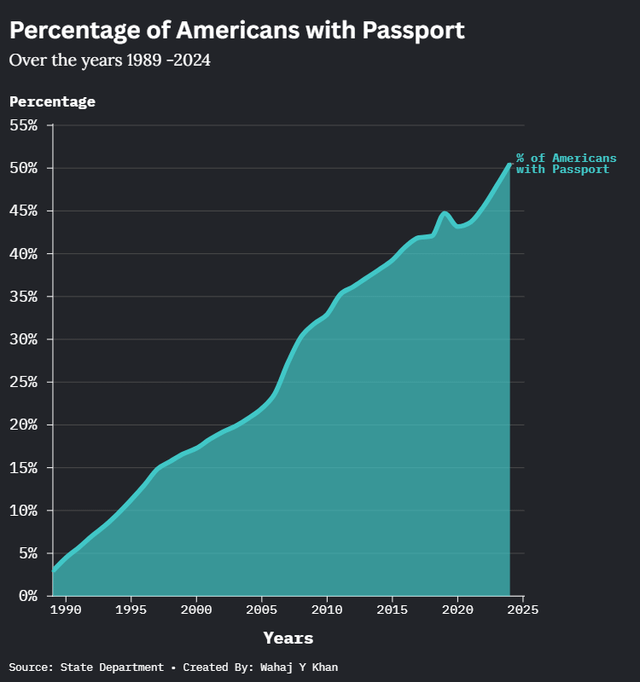
Travel looks less discretionary than the data suggests. Social media has altered demand for international travel. Whether it was London, Paris, Rome, or Florence, the museums, churches, and scenic areas were full of influencers doing video shoots, all of which encourage their followers to travel to the same sites.
It’s not surprising that, the global airline industry recorded its busiest day ever in late July.
Ultimately, people spend money on what they prioritize and travel has become an increasing priority. Especially in higher economic circles, it’s become table stakes.
Social media shows us what our peers are doing. If people similar to us start doing something, we subconsciously feel the need to do the same.
Importantly, the group that influences our peer comparisons has widened. When I was growing up in the 1980s, the people that my parents compared themselves with mostly lived in the same zip code. Today, parents can benchmark themselves (good or bad) with people from around the world.
Despite consumer worries about AI, geopolitical tensions, housing affordability, etc., international travel keeps plugging along. Perhaps it’s less discretionary than you think.
Payments in foreign currencies are simple now. When my wife and I lived in London 15 years ago, moving funds between currencies was a real pain. Paying for items in pounds using a US credit card came with high fees, as did moving money between my US and UK bank accounts. Back then, UK vendors disliked that our US credit cards were swipe cards and not chip-and-pin.
Today, none of those things are an issue. We used our Capital One Venture card with no foreign transaction fees for most of our spending and our Wise card to get access to cash when we needed it.
Europe conducts a lot of business via WhatsApp. Whether it’s communicating with a landlord, a hotel, or a merchant, a lot of European commerce is done on Meta’s WhatsApp in a way that is highly uncommon in the US.
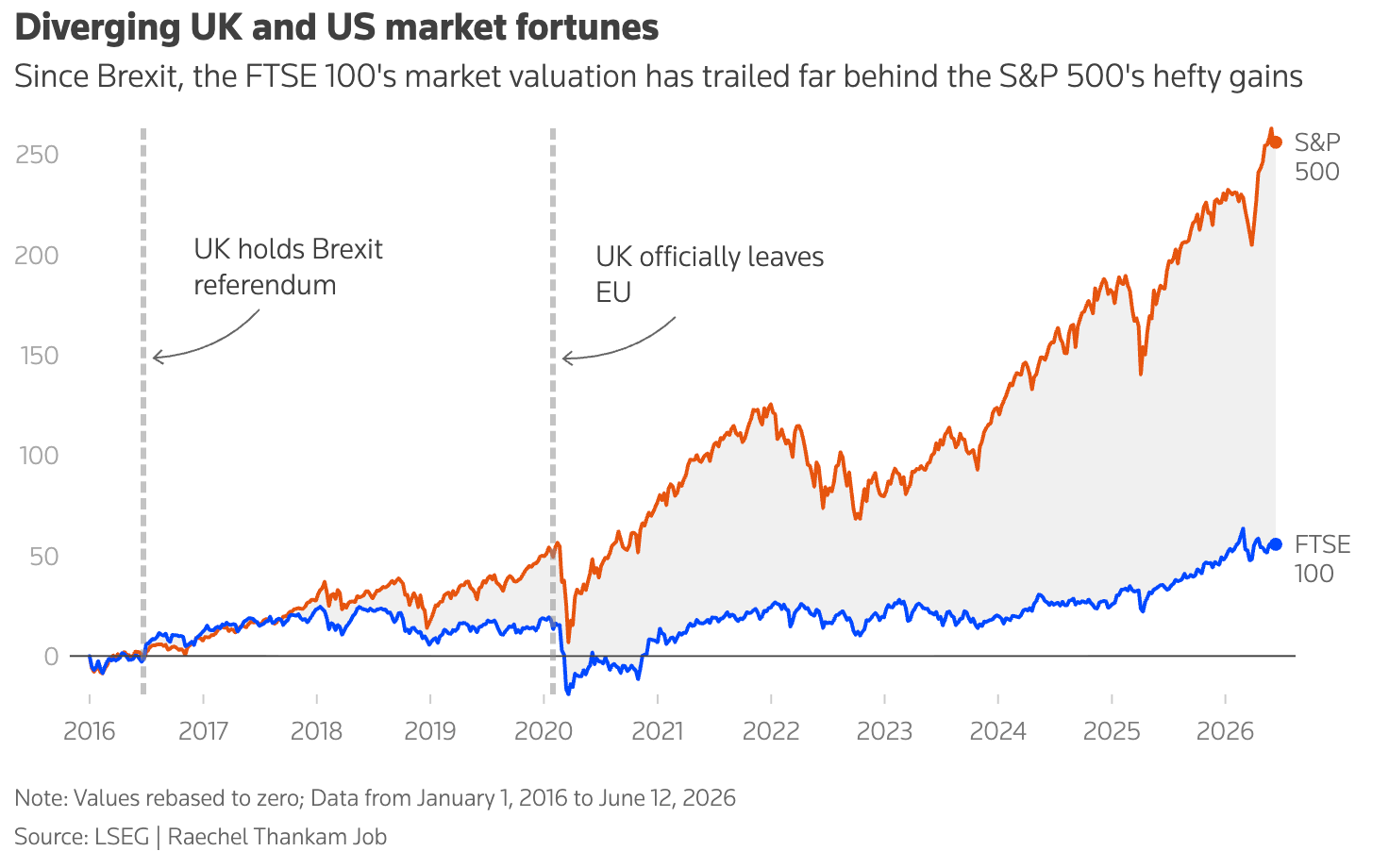
Europe’s economic energy feels slow relative to the US. London felt like it had less “buzz” about it than I remember 15 years ago, perhaps due to impacts from Brexit and ongoing housing weakness. The FT recently noted that UK companies are seeing increased “bear hug” acquisition strategies (where acquirers offer a big premium that the board will find hard to decline) from foreign acquirers partially due to a lack of enthusiasm from domestic investors.
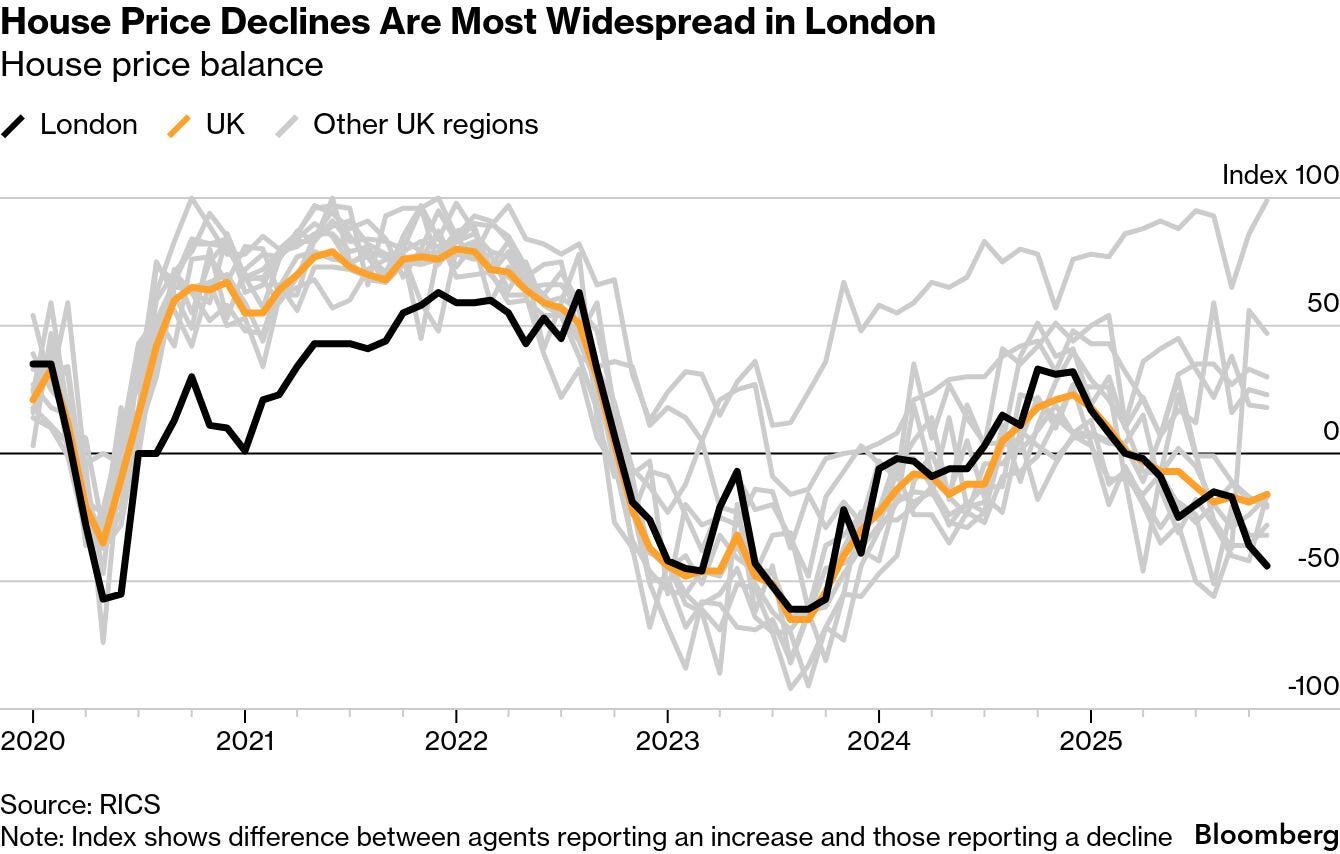
Other UK companies, such as Wise, Ferguson, and Flutter Entertainment (parent of FanDuel), have sought cross-listings in the US or dropping their UK listings altogether.
As a US investor, I’ve found good value in the UK markets in recent years, so I’m not complaining from that standpoint, but as someone who thinks a robust London and Great Britain is good for the global economy, I hope it gets the jumpstart it needs.
Vaping is everywhere. While you do see people vaping nicotine in the US, it’s a fraction of what you see in Europe. You can buy them 24/7 through street-level vending machines. Real cigarettes are also commonly seen, with people regularly smoking at outdoor restaurant tables. This is something you just don’t see in the US anymore.
US investors may have a natural aversion to tobacco/nicotine products, but their relevance remains strong in Europe. If you’re not against tobacco/nicotine products in principle, it’s a product category worth exploring.
Those are all of the investment takeaways from my trip. Here are some general thoughts about my time overseas.
It had been 15 years since I was last in London and I’ve resolved to come back more often. For me, it’s home away from home. It was great catching up with old friends and meeting investing friends I’ve only had online conversations with. There are a lot of companies I’d like to visit and people to meet that I didn’t get around to this time.
London is a delightful city for children. Mine are 11 and 8 and loved every minute of it. There are bountiful parks, free activities, and easy mass transit via the Tube and buses. Paris is similar, but without as many free activities. Rome is more ideal for older children and teenagers who’ve already had some exposure to Roman history and can better handle the walking. Rome is expanding its subway system, but it’s currently not very useful for tourists as it goes around the central historical area. Due to traffic and tight streets, Roman buses are not much faster than walking.
While AI combined with hardware (AirPods, Meta glasses, etc.) will continue to language barriers, there’s no substitute for conversing with someone in their language. My family and I spent six months learning Italian before our trip and it paid off many fold. Whether it was in a restaurant, in a taxi, or in a store, knowing conversational Italian was useful for communicating and led to some good conversations and moments we wouldn’t have otherwise had. I also genuinely enjoyed learning Italian and miss hearing its musical rhythms in the background.
One of the things I came to appreciate about Italian culture during my time there was the value they place on human connection. Our apartment was next to a nice restaurant and people were regularly outside talking until 2 a.m. Not in a sloppy drunk way like you might see outside a bar elsewhere, but having jovial conversations lubricated with a beverage of choice. Alcohol is consumed more responsibly to brighten experiences rather than to excess.
Bellying up to a coffee bar, placing your order face-to-face with the barista, having a brief conversation and consuming it on the spot is far superior to the zero human interaction that comes with mobile orders in the US. By the end of my time there, the barista knew my order. Yes, mobile orders may be more efficient, but they come at the cost of less human connection.
If you can help it, don’t travel to Rome in July. It is way too hot. Even if you are in good shape, it takes a lot out of you, especially if you’re trying to see all the sights in three or four days. I was really looking forward to our four days in Florence, but the oppressive heat diminished the experience.
Rome’s churches are spectacular and a great way to see art away from the museum crowds. A highlight of the trip was attending Mass at the Pantheon one Sunday and being able to view the building in relative privacy before the tourists were readmitted.
Our favorite trip during our time in Rome was to Siena. We arrived the day after Palio and enjoyed the ongoing festivities related to the tradition that traces its roots back to the medieval period.
The best family activities we did in Rome were (in order): an Italian cooking class at Walks Devour, going to new gelato spots every night, and a bike ride on the Appian Way.
The trip created lifelong memories for me, my wife, and my kids and I’m glad we did it.
Now back to your regularly scheduled Flyover Stocks programming.
For paid subscribers, I am catching up on Q2 earnings and will share some thoughts in the coming days.


Stay patient, stay focused.
Todd
Enjoyed this article? I write for investors who care more about process than predictions and regularly share thoughts on individual companies on my radar.
Join over 12,700 thoughtful investors who read Flyover Stocks.
Todd Wenning is the President & CIO of KNA Capital Management, LLC, an Ohio-registered investment advisor that manages a concentrated equity strategy and provides other investment-related services.
At the time of publication, the author, his immediate family, and/or KNA Capital Management, LLC or its clients own shares of Wise and Ferguson.
Please see important disclaimers.