
Seeking the Real McCoy
Why the "simulacra" of AI-generated content will only make the original creators more valuable.

Back in 2016, I listened to a Tim Ferriss podcast episode with marketing guru Seth Godin, in which Godin recommended reading a book called Pattern Recognition by William Gibson if you want to understand brands.
Godin emphasized that you didn’t even have to read the whole book - just the first five chapters!
I picked up a copy shortly after and it did in fact have a profound influence on how I thought about brands. This quote, in particular is one that I regularly refer back to:
“My God, don’t they know? This stuff is simulacra of simulacra of simulacra. A diluted tincture of Ralph Lauren, who had himself diluted the glory days of Brooks Brothers, who themselves had stepped on the product of Jermyn Street and Savile Row, flavoring their ready-to-wear with liberal lashings of polo knit and regimental stripes. But Tommy surely is the null point, the black hole. There must be some Tommy Hilfiger event horizon, beyond which it is impossible to be more derivative, more removed from the source, more devoid of soul. Or so she hopes, and doesn’t know, but suspects in her heart that this in fact is what accounts for his long ubiquity.”
Simulacra of simulacra of simulacra. A copy of a copy of a copy.

What consumers yearn for - and indeed are willing to pay for - is the fountainhead, or the spring of inspiration. In the Gibson book, the fountainhead for men’s shirts was Jermyn Street and Savile Row in London, where the finest shirts were made at prices only the wealthy could afford.
Brooks Brothers saw what was selling and made a lower quality copy of it at a lower price. Ralph Lauren then copied a lower quality version of Brooks Brothers. All the way down the line to Tommy Hilfiger, which apparently is the bane of Gibson’s existence.
If this sounds familiar, the lesson was echoed in the movie The Devil Wears Prada:
Think of the items you’ve purchased over the years that were a knock off of the Real McCoy (my faux leather couch example, again). It’s always a little bit…hollow. Isn’t it?
When I was growing up near New York City, we’d look at all the fake Rolex watches and fake Oakley sunglasses - “Folexes” and “Foakleys” - being hawked on the corners for 20 bucks or something. Even if you bought one, you knew yourself that what you had was a piece of crap. And the guy that took your 20 bucks was the only one who ultimately felt good about the transaction.
That’s because what you bought wasn’t the real thing.
In contrast, there is a certain magic and satisfaction that comes with buying the true object, even if it comes at a higher price. I think people, in their heart of hearts, understand this and want to support the creative spark that enabled the magical product.
It’s true there can be financial limitations - I for one would love to financially support the craftspeople at Ferrari or Patek Philippe for their beautiful art - but in principle at least I do believe that people want to support the fountainhead.
In fact, their eagerness to buy the copies - getting a whiff of the wellspring for 90% off - is evidence of this.
We saw this at Games Workshop when 3D printing became available to wider audiences. Some investors were naturally concerned that 3D printing would be the end of Games Workshop.
In the end, do some Warhammer fans sometimes print their own miniatures? For sure. Did they stop buying Warhammer games completely? No.
In my original profile of Games Workshop, I mentioned this quote from Reddit on the topic:
I’m quite happy with the idea of printing conversion pieces, or unique models - meaning you design a specific model for yourself and print it.
As a general principle, I’m not a fan of printing entire units or exact copies of official models. The main reason behind that is because as a player of the game, I am invested in the strength of the company that makes the game. Whatever other argument people want to make against GW, they are the source of the game I love to play, and I need them to be in a strong place so that they continue to support the game.
If every Warhammer player completely printed their own sets, it might have been cool…for a while. But then Games Workshop would have gone out of business. The creative minds that build the beloved narratives and worlds would have gone on to do something unrelated and the Warhammer flame would have been snuffed out.
So when recent news from Google’s Project Genie sent video game stocks crashing this week, I thought about the above lessons.
With a few prompts in Genie, anyone can now build their own video games - sometimes directly knocking off the intellectual property of the game publishers. This is illegal, of course, but that won’t deter everyone.
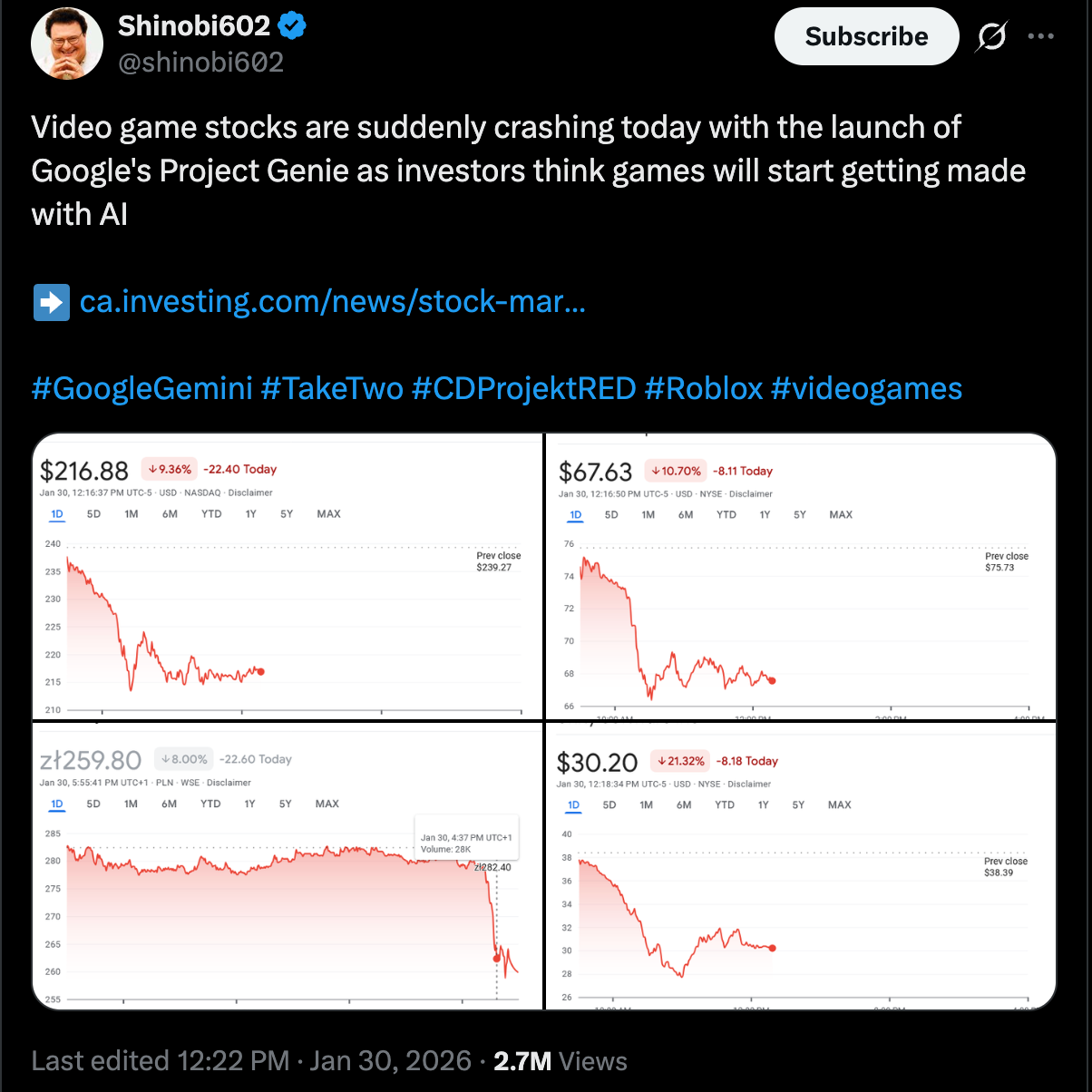
A video game selloff could get worse before it gets better, but I think it’s fair to be skeptical that everyone is going to just make their own games and video game publishers are toast.
Just because you can build a game that looks like Red Dead Redemption 2, or Grand Theft Auto, or Mario Odyssey doesn’t mean they’re those games.
They’re simulacrum. Copies. Hollow.
What’s more, think about how video game publishers might use the Google technology itself to make more and better games and bring them to you faster than before. Like Warhammer, the successful video game franchises are more than just games - they’re also communities and those take decades to build. You can prompt a world into existence, but you can’t prompt a culture.
Seth Godin’s recommendation to read Pattern Recognition was a game changer for me because it provided a lens to see through the noise. In a world about to be flooded with AI-generated simulacra, the value of the original will only skyrocket. Avoid the copies. Focus on the fountainhead.
Stay patient, stay focused.
Todd
Todd Wenning is the founder of KNA Capital Management, LLC, an Ohio-registered investment advisor that manages a concentrated equity strategy and provides other investment-related services.
At the time of publication, Todd, his immediate family, and/or KNA Capital Management, LLC (including its client accounts) owned shares of Games Workshop.
Content at Flyover Stocks is provided for educational, informational, and entertainment purposes only and should not be construed as individualized investment advice or a recommendation to buy or sell any specific security. All investments involve risk. Please perform your own due diligence or consult with a qualified financial advisor before making any investment decisions.
Please see important disclaimers.
Another excellent quote from this Gibson book-
“We have no future because our present is too volatile. We have only risk management. The spinning of the given moment's scenarios. Pattern recognition.”
That's an interesting quote from that redditor: GAW is "the source of the game I love to play, and I need them to be in a strong place so that they continue to support the game." It comes from a place of love. I can't help but wonder if the customers of mission-critical vertical market software feel a similar feeling. Even if it might not come from the same place of love, I think customers have a vested interest to continue paying whatever company to continue supporting the software upon which they rely for their livelihood.