
If Everybody Knows It's a Bargain, Where's the Alpha?; Company Updates
Exploring why so many quality managers cluster around the same ideas

It’s 13F season again and having read through some of them, it struck me that there’s a lack of best idea diversity among the larger, more famous active managers.
The likes of Visa, Mastercard, S&P Global, FICO, Google, Meta, Berkshire, etc. regularly turn up in the top five or ten holdings.
Part of this could be due to size. When you’re managing $1 billion, $10 billion, $100 billion, the universe of potential names to hold in size diminishes quite rapidly.
If you’re managing $10 billion and want to stay under the 5% ownership threshold, taking a 5% position in your portfolio likely means a market cap north of $10 billion for portfolio consideration.
Still, according to Koyfin, there are 465 U.S.-listed and headquartered companies with market caps over $20 billion today - plenty of cover above the $10 billion minimum. Of these, 185 have five-year average returns on invested capital over 12%, suggesting potential competitive advantages.
Ultimately, investing is about total returns, not creativity. Some of those names are trading with multiples around their decade lows. Maybe some of them are indeed bargains today.
That said, it gives me pause when I see consensus agreement among the largest investors in the quality-style world. If “everybody knows” a company is a bargain, where’s the opportunity for alpha?
It’s hard to bemoan the death of active management when the faces of the industry are clustered in the same 10 names.
Perhaps it’s a self-reinforcing cycle where the threat of departing AUM is encouraging a herding mentality among large managers.
As individuals and smaller managers, we don’t have to play the same game. This is exactly why I keep looking for ideas the Street overlooks or misunderstands.

Ferguson (FERG)
On that note, in my profile of Ferguson from August 2025, I said that its inclusion in the S&P 500 was “inevitable.” Well, the day finally arrived, with Ferguson officially joining the S&P 500 on August 5, 2026.
While the inclusion in the S&P 500 doesn’t change anything about Ferguson’s day-to-day operations or intrinsic value, it gives Ferguson a larger profile and more investor attention. Increased capital flows to the stock should increase liquidity, as well.
Of course, it’s hard to make a case that it flies under the radar anymore!

Garmin (GRMN)
Garmin might end up being a company I’ll regret not investing in earlier this year.
To be fair to myself, it wasn’t optically cheap relative to its 10-year history, but it’s nevertheless generated total returns over 50% in the last six months.
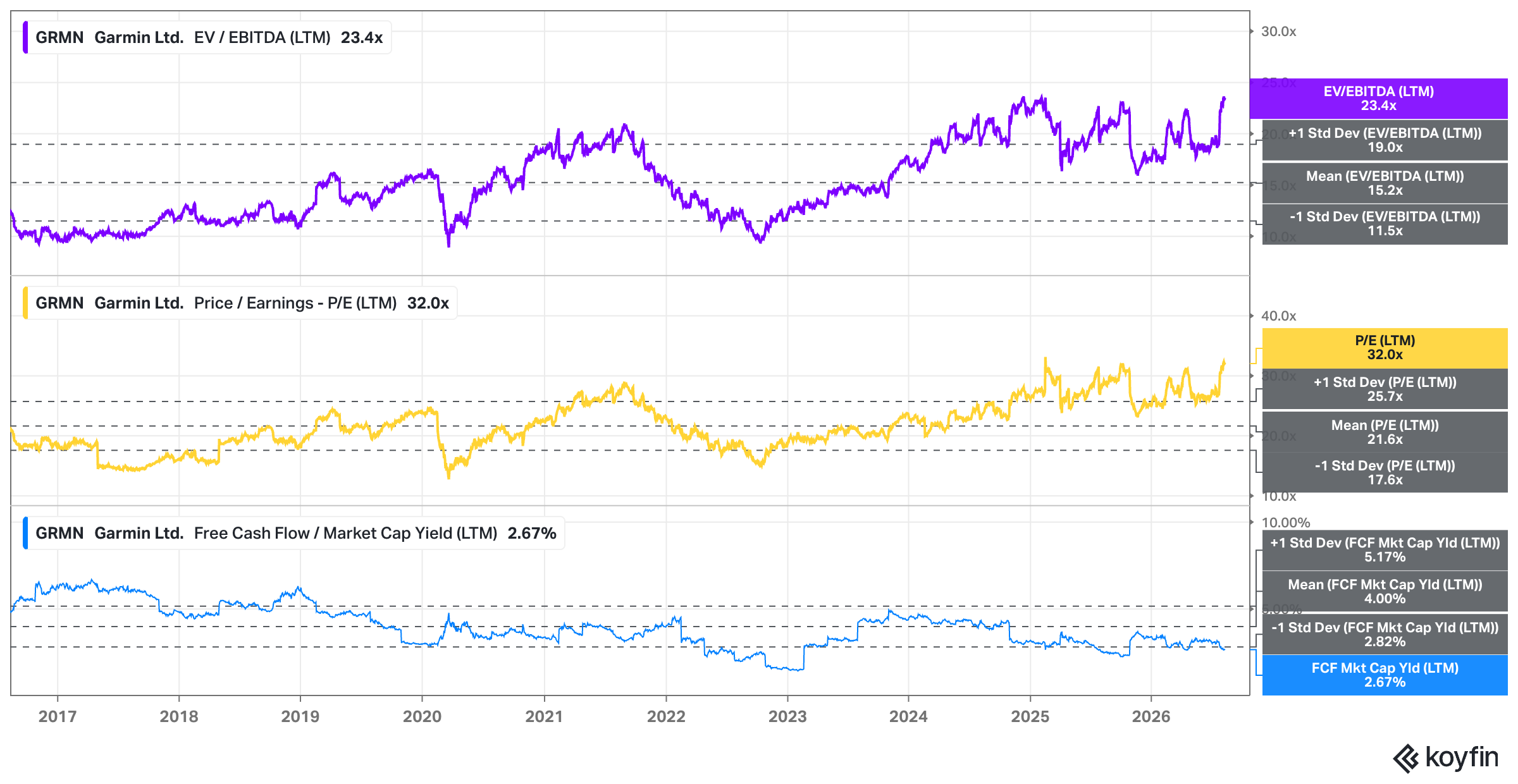
But those multiples may well be justified. Across its product categories, Garmin has been able to maintain a differentiated offering, despite facing much-larger, better-capitalized competitors like Apple, Google, Honeywell, Samsung, and Raytheon.